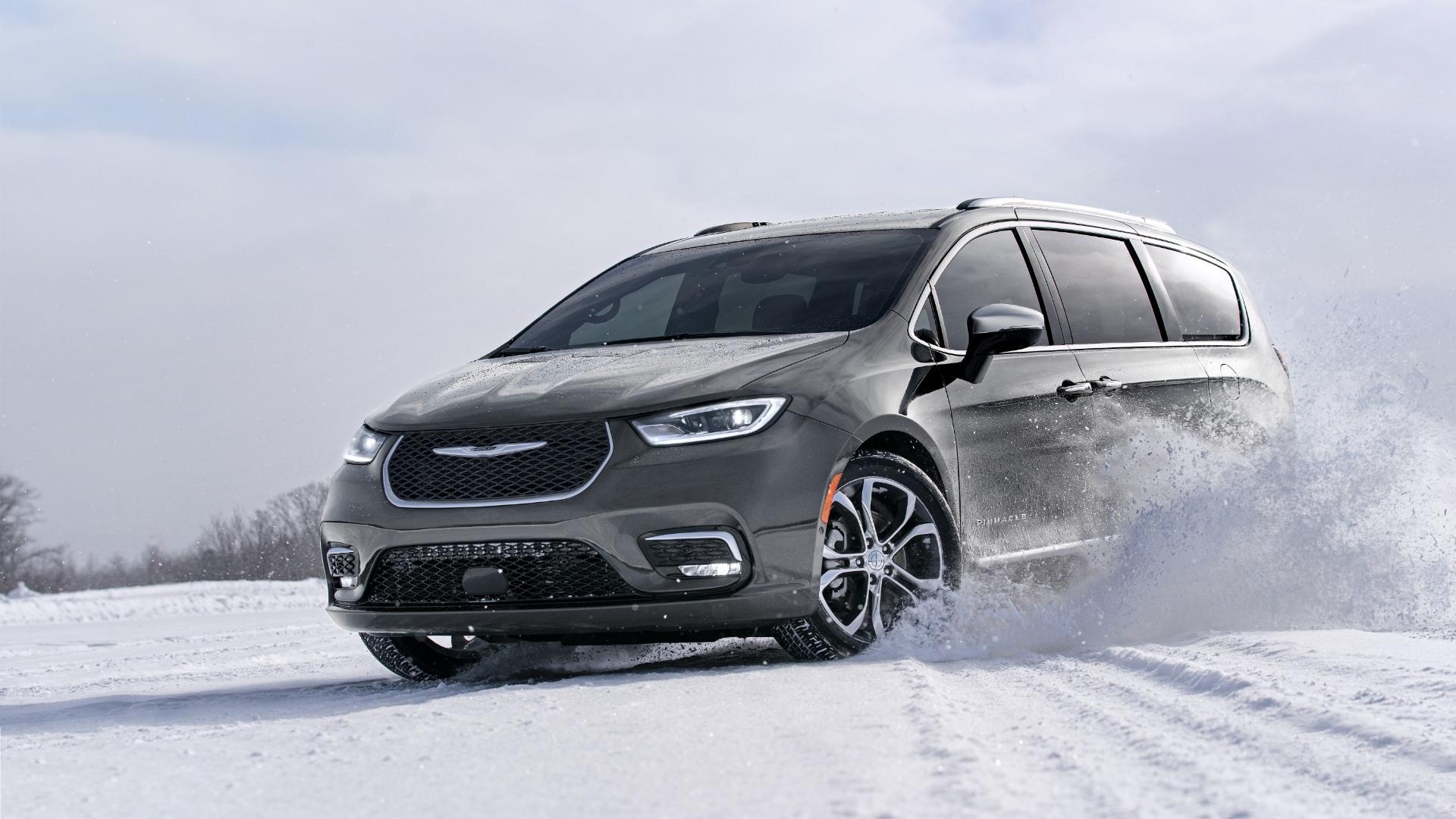
CHRYSLER Pacifica 2022
The dean of minivans has nothing to envy of its newer rivals
Pros and cons
Pros
- Unrivalled versatility
- Successful hybrid powertrain
- Balanced road behaviour
- Excellent visibility
- Rich finish
- Generous equipment
Cons
- Exaggerated pricing (gasoline models)
- Transmission hesitation (gasoline models)
- Some body and trim rattles
- Overly firm front seats
- Towing package no longer available (except on Pinnacle)
- Inconsistent reliability
Overview
Chrysler improved the styling, safety, technology and equipment of the Chrysler Pacifica in 2021 and added all-wheel-drive as an option on gasoline models. The goal was to clear the way for the new generation of the Grand Caravan, which is identical to the base versions of the 2017-2020 Pacifica. This year, several formerly optional features are delivered standard. That raises the entry price significantly, especially with the elimination of the most affordable variant of the Pacifica plug-in hybrid.
Despite all that, the Touring-L Hybrid is still the least expensive Chrysler Pacifica model, at $45,883. For that we can thank government rebates for electrified vehicles that knock $13,000 off the retail price of the plug-in hybrid models after taxes (or $11,307 before taxes). The gas-engine Touring-L sells for $53,790; all-wheel drive adds another $3,700. Topping the lineup, an AWD Pacifica Pinnacle rolls in at $71,920! And in light of tight supply since 2021, we can forget about the traditional manufacturer discounts.
In comparison, a Toyota Sienna Limited AWD tops out at $61,435, which works out to $240 less (4-year lease) or $415 less (6-year purchase finance) per month than a fully equipped Pacifica.
All Chrysler Pacificas and Dodge Grand Caravans are assembled in Windsor, Ontario.
Verdict
The Chrysler Pacifica is still best-in-class in terms luxury, versatility and refinement. What’s more, the plug-in version becomes the most eco-energetic when used, even a little, in electric mode. It is also the model that makes the most sense financially. As pleasant and well-designed as they may be, the gas-only models are more expensive than their more reliable Japanese rivals. And that’s not counting the Kia Carnival, whose quality-space-price ratio is currently unbeatable.
Evaluation
Body, cabin and cargo space
With their generous dimensions, minivans are mini no more. Hybrid or classic, the Chrysler Pacifica can accommodate seven passengers in perfect harmony. An eighth person can even fit into a two-wheel-drive Touring-L equipped with the Uconnect Theater Family group.Certain rival vehicles have rear bucket seats that slide back to create a limousine-like experience, but not the Chrysler Pacifica. With the Pacifica, on the other hand, along with its Chrysler Grand Caravan cousin, those seats fold into the floor, even on vehicles with all-wheel drive. The feature does not work with the electric powertrain, however, because of space requirements for the battery. Instead, the hybrid uses removable captain’s chairs, better padded than the fold-down buckets and also used on the gasoline-engine Pinnacle models that are even more luxury-oriented than the other versions.
The rear bench on all models also stows away into the floor. Folding all the rear seats creates a flat surface with room for several sheets of 1.2 m X 2.4 m (4 ft. X 8 ft.) plywood. All models are now delivered with sliding doors and a power liftgate, with hands-free opening on high-end models.
The Pacifica Pinnacle we tested recently displayed by far the best finish and materials of the segment. Even the models without the chic quilted leather trim prove very inviting. The front seats provide good overall support, but after a few hours, some testers found them too firm. The wide centre console somewhat hampers the driving position, which is otherwise a good cross between that of a station wagon and a pickup.
The 2021 Chrysler Pacifica launched the new generation of the Uconnect infotainment system made by Stellantis (formerly FiatChrysler Automobiles). The clear and responsive 25.7 cm (10.1 in.) touch screen overflows with information and personalization settings. However, it is a bit more complex than the former interface, which was praised for its simplicity.
A good sprinkling of hard buttons and knobs provide access to the main functions; only the seat and steering wheel heaters require searching through the screen menus. There are as many types of centre consoles as there are models, but all versions offer an abundance of storage spaces and cup holders.
Other highlights
Convenience: Chrysler has integrated the content of several options groups into the standard equipment, depending on the model. That makes it easier to order a vehicle but raises the entry price. A tire repair kit is now standard, and it is no longer possible to obtain an inflatable spare. The practical factory-installed towing package that distinguished the Pacifica from all its rivals is now restricted to the Pinnacle version.
Instrumentation: gauges are attractive and easy to read. The standard 17.8 cm (7 in.) information display screen is comprehensive and practical. No head-up display is available.
Safety features
- Antilock brakes with electronic brake force distribution and brake assist
- Stability and traction control
- Front airbags
- Front knee airbags
- Front side airbags
- Side curtain airbags
- Seven or eight head restraints, folding or removable depending on model
- Rear passenger detection
- Rearview camera
- Tire pressure monitoring
- Forward collision warning with automatic forward emergency braking and pedestrian detection
- Blind-spot monitoring
- Rear cross traffic warning
- Lane-departure warning
- Automatic high beams
- Rear parking sensors with automatic reverse emergency braking
- Adaptive cruise control
- Front parking sensors and surround view monitoring (standard, Touring-L, Limited and Pinnacle; unavailable, Touring)
Crash test results
National Highway Traffic Safety Administration (NHTSA)Overall score: 5 / 5
Frontal impact: 5 / 5
Side impact: 5 / 5
Rollover resistance: 4 / 5
Insurance Institute For Highway Safety (IIHS)
Moderate overlap frontal impact: 4 / 4
Small overlap frontal impact:
- driver side: 4 / 4
- passenger side: 4 / 4
Side impact: 4 / 4
Rear impact: 4 / 4
Roof strength: 4 / 4
IIHS Top Safety Pick+
Visibility
In typical minivan fashion, the expansive glass surface provides very good visibility, front and side. The positioning of the door mirrors, slightly offset rather than on the edge, also opens the view at intersections. The backup camera and surround view system facilitate parking. Blind spot monitoring is finally standard.Headlights: LED headlights are standard but yet to be tested by the Insurance Institute for Highway Safety.
Mechanical overview
The Chrysler Pacifica was built on a new platform at launch and kept only the gasoline engine of the former generation of the Dodge Grand Caravan. It is therefore fully competitive mechanically, except for its rear suspension, still a semi-independent torsion beam setup rather than multi-link like the other minivans.The gas-engine Chrysler Pacifica comes with a 3.6‑litre V6 widely used in Stellantis vehicles sold in North America. Called Pentastar, in this case the engine produces 287 horsepower and 262 pound-feet of torque at 4000 rpm. Those ratings are comparable to the other gas engines of the segment.
Matched to the engine is an automatic transmission created by German firm ZF and made under licence by Stellantis. It has nine speeds but no manual mode, which would be useful when towing or driving on mountainous roads.
The optional all-wheel-drive system directs a portion of the power to the rear wheels only if necessary, such as in case of front wheel slippage. The rear driveshaft disengages completely in normal driving to improve fuel economy.
According to Natural Resources Canada, this AWD system imposes a 1.4 L/100 km penalty at the pump, for a combined city/highway fuel consumption rating of 12 L/100 km. We recorded 10.8 L/100 km with an AWD Pinnacle during our summer test, two-thirds on the highway.
In comparison, our last test of a plug-in hybrid model yielded an average of 5.9 L/100 km. No less than 41 percent of the 1,138 km in one week of driving was in purely electric mode thanks to the claimed range—highly realistic, at least in warm weather—of 51 km. Recharging the battery with a 240-volt charger takes two hours, and around 14 hours with a 120-volt charger.
The battery has a capacity of 16 kWh, which is enough to qualify the Pacifica Hybrid for the maximum rebate of both governments for electrified vehicles. The battery powers a pair of electric motors integrated with an electronic continuously variable transmission. Together with an Atkinson-combustion-cycle variant of the 3.6‑litre V6, this drivetrain delivers 260 horsepower.
Though power is close to that of the gasoline-only engine, Chrysler does not recommend towing with the hybrid. Gas-engine models have a tow rating of 1,633 kg (3,600 lb).
Driving impressions
With the retirement of the Dodge Grand Caravan at the end of 2020, the Chrysler Pacifica becomes the oldest of the current crop of minivans. However, it has nothing to envy the competition in terms of handling.On the contrary: with the exception of the Honda Odyssey, none of the others can rival the balanced everyday driving of the Pacific. Despite its relative simplicity, the suspension effectively controls body lean in turns without punishing the occupants on degraded pavement. There is none the stiffness sometimes felt with a Toyota Sienna XSE or the exaggerated body movements of a Kia Carnival.
Even if the big 20‑inch tires on the top-end models do not transmit every bump, they seem totally pointless on this type of vehicle. It is true that the 17‑ or 18‑inch tires on the lower-echelon models reduce a bit of the already limited road feedback, but the good precision and weighting of the steering remain intact. The smaller tires are also quieter.
Gas-only or electrified, the Pacifica always proves enjoyable and amply energetic. However, the hybrid powertrain wins the day in nearly every respect: smoothness, flexibility, quietness and, obviously, frugality. The North-American engineers at Stellantis have really surpassed themselves with this system.
The gasoline V6 is no slouch, either. Its automatic transmission has become smoother over time, though it can still hesitate when downshifting. But the only logical reasons to purchase a non-hybrid Pacifica are if all-wheel drive is an absolute necessity—which is relatively rare, when you think about it—or you have to tow a trailer.
Judging by the prevalence of the plug-in version on our roads, Quebec drivers seem to agree.
Other highlights
Braking: pedal on the gas-engine model is soft initially but power is good thereafter. Regenerative braking on the hybrid is very effective at maintaining battery charge and barely perceptible on the pedal.
Driver assistance: adaptive cruise is well tuned. Drivers who prefer to set their own distance from preceding vehicles will appreciate being able to revert to regular cruise control via a clearly identified button on the steering wheel. Lane-departure warning is sometimes abrupt; it too can be switched off via a large button that is easy to find.
Features and specs
Price range (including shipping and preparation) | ||
| Minimum price | $52,690 | |
|---|---|---|
| Maximum price | N/A | |
| Price as tested | $71,770 | |
| Trim levels | Touring (gas only)
Touring-L
Limited
Pinnacle | |
Honda Odyssey | ||
Kia Carnival | ||
Toyota Sienna |
| Engine, horsepower and torque | 3.6L V6; 287 hp at 6,400 rpm; 262 lb-ft at 4,000 rpm
3.6L V6 with two electric motors and 16 kWh lithium-ion battery; combined output: 260 hp; undisclosed combined torque
Range: 51 km
Level 2 complete charge (240 V): 2 hrs |
|---|---|
| Transmission | 9-speed automatic (gas)
Continuously variable transmission (Hybrid) |
| Front suspension | Independent with MacPherson struts |
| Rear suspension | Semi-independent with torsion beam |
| Front brakes | Ventilated disc |
| Rear brakes | Disc |
| Tires | 235/65R17
235/60R18
245/60R18
245/50R20 |
| Wheelbase | 308.9 cm | ||
|---|---|---|---|
| Length | 518.9 cm | ||
| Width | 202.2 cm | ||
| Height | 177.7 cm
179.6 cm (all-wheel drive) | ||
| Curb weight | From 2,050 to 2,273 kg
2,214 kg | ||
| Towing capacity | Gas: 1,633 kg (3,600 lbs); Hybrid: not recommended | ||
According to Natural Resources Canada | ||
| City | 14.1 L/100 km (gas engine, all-wheel drive) | |
|---|---|---|
| Highway | 9.4 L/100 km (gas engine, all-wheel drive) | |
As measured by CAA-Québec | ||
| City | 10.8 L/100 km (gas engine, all-wheel drive) | |
| Highway | N/A | |
| CO2 emissions | 5,580 kg/20,000 km (gas engine, all-wheel drive) | |
| Fuel tank | 62.5 litres (Hybrid)
71.9 litres (gas) | |
| Recommended fuel | Regular-grade gasoline | |