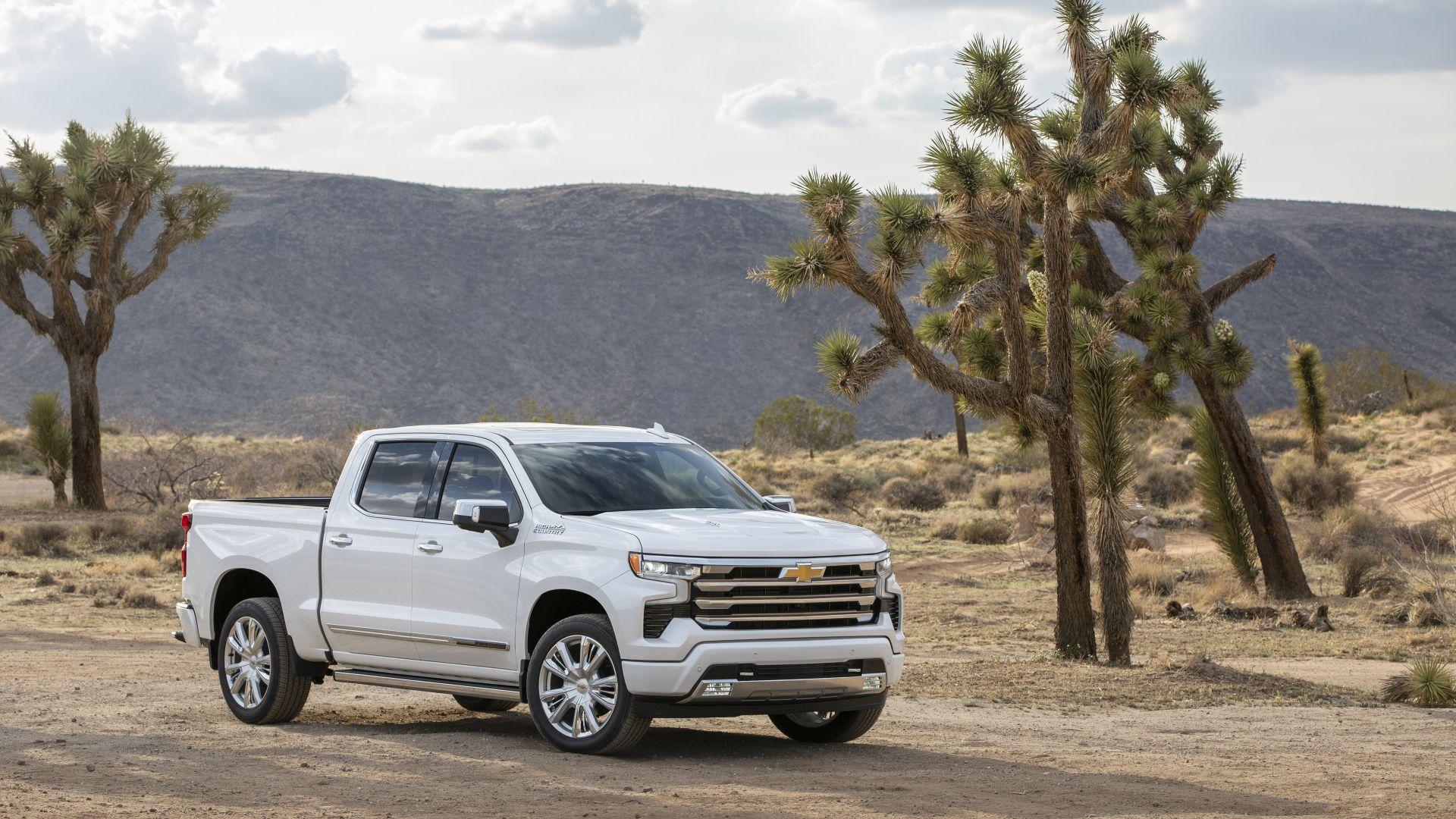
CHEVROLET Silverado 2022
A high price tag that gives pause ...
Pros and cons
Pros
- Impeccable diesel and 6.2-litre V8 engines
- Benchmark 10-speed transmission
- Balanced ride (adaptive shocks)
- Vast cabin (crew cab)
- Improved finish and technology (LT trim and up)
- Driving assistance now standard
Cons
- Overly light steering
- Firm suspension (regular shocks)
- Cheap cabin (WT and Custom trims)
- Uninviting seats
- Increased prices
- High operating costs (diesel engine)
Overview
American manufacturers are constantly battling for a dominant share of the lucrative full-size pickup market. Chevrolet’s latest bid is a mid-cycle refresh of the Silverado, nearly four years since its last remake. Chevrolet redesigned the interiors of the high-end versions, launched an off-road version, the ZR2, and simplified the list of engines. It will be another year before an electric version of the Chevrolet Silverado becomes available, whereas the Ford F‑150 Lightning is already circulating on our roads.
In the meantime, potential buyers of Chevrolet’s best-seller will have to deal with a substantial increase in prices. As an example, the Silverado High Country we tested was priced at $89,928 last July, when GM Canada presented it to the specialised press. However, the Website calculator indicated $94,723 for the same pickup when this article was published at the end of September 2022. While this includes an exorbitant destination fee of $2,095 and $14,000 worth of optional equipment, it illustrates the extent to which big pickups have become a luxury item.
Cheaper options are, of course, available but below $60,000, you can forget about that monochrome V8 Silverado with gorgeous black wheels you see every morning in your neighbourhood. A base WT model now goes for close to $45,000 in a two-wheel-drive, regular-cab configuration that almost no one wants these days. It costs around $10,000 more to get a four-door extended cab and four-wheel drive, in a very pared-down trim. And with current inventories so tight, there obviously are no manufacturer incentives to lower the price
To be fair, competing brands have also increased their prices. The only holdout is the RAM 1500 Classic, but it is an older-generation truck that cannot claim the same level of refinement as its more modern rivals.
GM began manufacturing the Chevrolet Silverado at its plant in Oshawa, Ontario, last July. It is also assembled in Indiana and in Mexico.
Verdict
Thanks to their redesigned cabin, the high-end Chevrolet Silverados now have little to envy their Ford and RAM rivals in terms of refinement. The 6.2-litre V8 is particularly advanced, and more energy efficient than you’d think, but it is expensive. In fact, the high price of the Silverado is something to ponder, especially the entry-level models with their cheap interior, firm suspension and, for certain buyers at least, eyebrow-raising four-cylinder base engine.
Evaluation
Body, cabin and cargo space
The first refreshed Chevrolet Silverados appeared in the spring of 2022. Per current trends, each model offers a unique grille. In fact, the catalogue is bursting with personalization options, including black badges, assist steps of every shape and wheels of up to 22 inches.
Our test model was fitted with 22-inch gloss black wheels, a $4,650 option, along with retractable assist steps that add another $1,380. Though we have never run into problems with the latter, motorized parts like these never fare well with the road salt used on our roads in the winter.
The height of the Silverado—like all its rivals—makes assist steps a virtual necessity, but the fixed models are your best bet. Once you’ve climbed inside, it’s the space that impresses first, at least in the crew cab. There is ample room for five tall people plus their personal effects at their feet, if necessary.
The large front seats will no doubt suit heavily built individuals, but poor side support and firmness hamper comfort. Despite the height of the cabin, you can sit low enough to avoid feeling perched. Concerning the driving position, it is important to note that the telescoping steering wheel is restricted to LT trim and higher; WT, Custom and Custom Trail Boss versions have tilt adjustment only.
The latter three trims, the most affordable of the lineup, are also deprived of the redesigned interior the Silverado launches in 2022. It is unfortunate, since this latest effort by Chevrolet corrects one of the pickup’s main weaknesses since the 2019 remake. A pair of large, logical and impeccably clear digital screens now dominate the dash, which still retains a good number of buttons and control knobs. The infotainment system integrates a suite of Google applications as well as wireless Android Auto and Apple CarPlay.
With the bucket seats there is now a console-mounted electronic gear selector, instead of a traditional lever on the steering column. Soft-touch materials replace several hard plastics, genuine wood trim appears on High Country models, and overall fit seems more precise than before. Finish is still not on a level of a RAM 1500 Longhorn or Limited, but close.
Safety features
Antilock brakes with electronic brake force distribution and brake assist
Stability and traction control
Hill start assist
Hill descent control (with 4X4)
Front airbags
Front side airbags
Side curtain airbags
Three, five or six head restraints (adjustable on front outboard and middle seats, folding on outboard rear seats)
Rear passenger alert
Tire pressure monitoring with pressure alert
Backup camera
Forward collision warning
Automatic emergency braking with pedestrian detection
Lane departure warning with automatic steering assist
Automatic high beams
Blind-spot monitoring and rear cross traffic alert, with or without automatic braking depending on model (standard, LTZ, High Country and ZR2; optional, WT, LT, LT Trail Boss and RST; unavailable, Custom and Custom Trail Boss)
Rear pedestrian alert and surround view cameras (standard, LTZ, High Country and ZR2; optional, LT, LT Trail Boss and RST; unavailable, WT, Custom and Custom Trail Boss)
Crash test results
National Highway Traffic Safety Administration (NHTSA)Overall score: 5 / 5
Frontal impact: 4 / 5
Side impact: 5 / 5
Rollover resistance: 4 / 5
Insurance Institute For Highway Safety (IIHS)
Moderate overlap frontal impact: 4 / 4
Small overlap frontal impact:
- driver side: 4 / 4
- passenger side: 2 / 4
Side impact: 4 / 4
Rear impact: 4 / 4
Roof strength: 4 / 4
Visibility
Generally good, notably thanks to large side mirrors that even allow you to tow a small trailer without installing extendable mirrors. Optional vertical trailering mirrors are available to help when towing larger trailers. The height of the cab may hide obstacles, children or animals from the driver’s view; the surround-view system is recommended.
GM should offer blind-spot monitoring as standard equipment on all models instead of bundling it in costly optional packages. The multi-angle backup camera and optional Hitch View are a great help when hooking up a trailer.
Mechanical overview
The new, top-of-the-line Chevrolet Silverado ZR2 raises off-road capability to an even higher level than the Trail Boss models, thanks to special shock absorbers, increased suspension travel, electronic locking front and rear differentials, 33‑inch all-terrain tires and custom bumpers. Powered exclusively by a 6.2-litre V8, it competes with the Ford F-150 Raptor, even though the latter is more powerful.
Chevrolet has housecleaned the powertrain menu of the other Silverados. The 4.3-litre V6 of the more affordable models is replaced by a 2.7-litre four-cylinder that was already listed. Now standard on WT, Custom and LT versions (including Trail Boss variants), it should find more takers than before. GM raised its torque to 430 pound-feet, an increase of 24 percent relative to the 2021 version, an impressive value that easily surpasses that of the 5.3-litre V8.
Unconditional fans of this V8 can rest assured: it is standard on RST, LTZ and High Country models and optional on all other versions except the Custom and ZR2. Like the ZR2, LT Trail Boss, RST, LTZ and High Country models can receive a 6.2-litre V8 that outputs 420 horses, the maximum for the lineup.
The torque of this engine, rated at 460 pound-feet, is identical to that of the 3.0-litre turbodiesel in-line six cylinder. However, the latter delivers it at a much lower RPM than the V8. The 2023 model-year will bring in a new version of the diesel engine that will boost torque to 495 pound-feet while lowering fuel consumption.
That is something of significance, because even though the diesel engine is the most fuel efficient of the lineup, diesel fuel regularly costs more than gasoline at the pump. In addition, it requires a 20-litre fill-up of urea (at around $60) every 10,000 km, or more often, depending on driving conditions. Engine oil also costs more for a diesel than for a gasoline engine. Therefore, even though Chevrolet only charges a low supplement for the diesel, the payback period is long.
All engines are now mated to a 10-speed automatic transmission, with the exception of the four-cylinder, which uses an 8-speed. The all-wheel-drive system includes an automatic mode on all versions, which is not the case with Ford, for example. It eliminates having to wait for the road to become slippery to switch to 4X4 mode, avoiding unpleasant surprises on roads spotted with black ice, for example.
Towing capacity varies from 4,037 kg (8,900 lb) to 6,033 kg (13,300 lb), depending on the cab, bed, drivetrain and engine. For example, an extended cab model with a short bed and four-wheel drive can tow 4,082 kg (9,000 lb) with the four-cylinder or the diesel engine, 4,128 kg (9,100 lb) with the 6.2-litre V8 and 4,173 kg (9,200 lb) with the 5.3-litre V8. A Max Trailering Package is required to obtain the maximum capacity with the six-cylinder and the two V8’s.
In terms of fuel economy, our 6.2-litre High Country tester delivered an average of 13.4 L/100 km. That bettered Natural Resources Canada’s combined city/highway rating, even though we were towing a trailer weighing around 907 kg (2,000 lb) on about 20 percent of our 1,100 km route. When not towing, we recorded 12 L/100 km, equivalent to the official rating for city driving; strictly on the highway, the trip computer even showed a reading of 10.5 L/100 km. Not bad for such a big engine!
Driving impressions
All of today’s full-sized pickups can be intimidating in terms of weight and size. However, the engineers have done wonders in dissimulating both when the vehicle is moving.
The Silverado is a clear example, first of all for its faultless stability at highway speed. The steering is light and rather uncommunicative, but it tracks well on the highway and responds precisely to steering inputs. After several hours behind the wheel, it is easier to understand why so many motorists drive pickups even though they do not need the load or towing capacity.
In this respect, our small (907 kg/2,000 lb) trailer was almost unnoticeable behind the pickup. The 6.2-litre engine had tons of reserve power climbing the hills on our route in the Beauce region; it even took the liberty of settling in at 1,600 rpm, in tenth gear, on certain flat, straight sections.
And so much the better; while our tester’s performance exhaust system highlighted the big V8’s melodious acceleration note, it also rendered it a bit too intrusive at cruising speed. Passing on this option allows you to fully enjoy the excellent soundproofing while saving $2,370.
However, we would willingly pay the extra $1,080 for the adaptive suspension that equipped our tester. Thanks to the electromagnetic shock absorbers, this system delivers a superbly smooth ride without impacting road holding, even with the 22‑inch low-profile tires. It also eliminates a major irritant of the other Silverados, i.e., the firm suspension that causes the rear axle to hop too easily. Unfortunately, this option is restricted to the High Country, with prices starting at over $80,000.
Other highlights
Braking: powerful and straight, with a pedal that is firm but not as hard as before, which ensures instant bite.
Driving assistance: lane-departure alert is well calibrated; we found the seat vibration less irritating than the steering-wheel vibration used by several competing brands. GM’s cruise control system can now be switched to a conventional mode by pressing and holding the cancel button.
Features and specs
Price range (including shipping and preparation) | ||
| Minimum price | $45,298 | |
|---|---|---|
| Maximum price | N/A | |
| Price as tested | N/A | |
| Trim levels | N/A | |
| Wheelbase | N/A | ||
|---|---|---|---|
| Length | N/A | ||
| Width | N/A | ||
| Height | N/A | ||
| Curb weight | N/A | ||
| Towing | Not recommended | ||