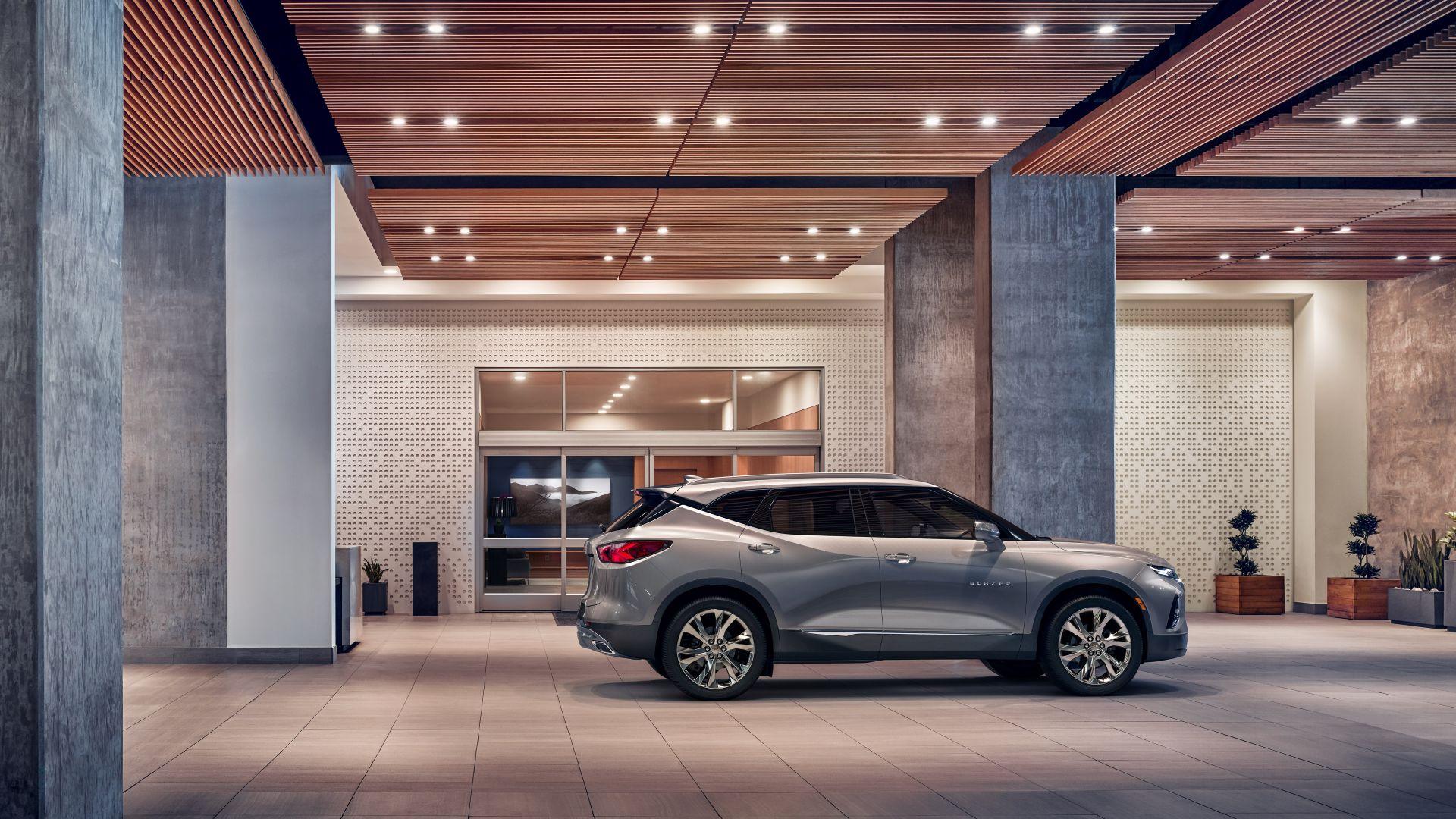
CHEVROLET Blazer 2022
One of the most enjoyable midsize SUVs to drive
Pros and cons
Pros
- Excellent balance of comfort and handling
- Exemplary transmission
- Smooth and powerful V6 engine
- Precise steering
- Efficient all-wheel drive
- Simple controls
Cons
- Just-adequate rear space
- Disappointing trunk
- Mediocre rear visibility
- Blind-spot monitor is optional
- Comparatively underequipped
Overview
Chevrolet has announced a 100-percent electric Blazer for 2024, but in the meantime it is business as usual for the gasoline version. Though a minor refresh is on the horizon for 2023, the main recipe will stay the same as this year’s. We therefore reconnected straight away with this five-passenger midsize SUV, which competes with the Ford Edge, Honda Passport and Jeep Grand Cherokee, among others. Like most contemporary Chevrolet Blazers, our test model came with a V6 engine, all-wheel drive and a towing capacity of 2,041 kg (4,500 lb).
Retailing between $42,000 and $56,000, the Chevrolet Blazer is priced midrange in its category. Only the Hyundai Santa Fe and Nissan Murano are more affordable, similarly equipped, but the former does not offer a V6 and the latter has not been updated in a long time.
General Motors assembles the Chevrolet Blazer in Mexico.
Verdict
Back on the market for nearly three years, the Chevrolet Blazer continues to stand out for driving enjoyment. Few rivals deliver the same level of handling composure and powertrain refinement. However, several competitors offer more interior space and versatility, two important criteria for crossover buyers. Nevertheless, the Blazer nicely spans the gap between the limited capacities of a compact four-cylinder SUV and a large, seven-passenger midsize.
Evaluation
Body, cabin and cargo space
The Chevrolet Blazer is 21 cm longer than the Chevrolet Equinox, with 14 cm more wheelbase, yet its interior is really only roomier in width. It can accommodate four adults but with less space than most other five-passenger midsize SUVs.The Blazer also offers less trunk space than several rivals. The fault lies in the height of the floor and the slope of the rear window. The rear seatbacks fold 60/40 to lengthen the cargo surface, but again, certain competitors offer the extra versatility of a separate-folding middle section.
Front occupants are the most pampered, thanks to well-padded seats, whether fabric or leather trimmed. They provide good support even on long trips; adjustable lumbar and driver-side thigh support are standard on all trims. The driving position is elevated but not too high perched. The well-positioned armrests and driver footrest reinforce driving enjoyment.
The dashboard is an attractive blend of original styling and functional design. The centre air vents take their visual cue from the sporty Camaro, and they have round rims that turn to adjust cabin temperature. There are separate buttons for climate control, which though too small are still easier to use than controls integrated into a touch screen.
The centre screen is clear and logically organized, with physical buttons for the main functions. All that is missing is a tuner knob. The eight-inch screen does a good job but the ten-inch screen promised for 2023 will bring the Blazer more in tune with the times.
Chevrolet will also include wireless charging at no extra charge on RS and Premier trims, a feature that right now is bundled in a $1,995 package. Hopefully it will at least be optional on LT and True North models, as well as the heated steering wheel also restricted this year to the highest-priced trims.
Right now, a heated steering wheel is listed but only theoretically; because of the chip shortages afflicting the entire automotive industry, Chevrolet has temporarily deleted it for certain Blazers manufactured since the fall of 2021. The same goes for the cooled front and heated rear seats; dealers will, however, be able to reactivate them once parts become available.
Safety features
- Antilock brakes with electronic brake force distribution and brake assist
- Front airbags
- Driver knee airbag
- Front side airbags
- Side curtain airbags
- Five head restraints, adjustable on outboard seats and folding on middle seat
- Rear passenger alert
- Tire pressure monitoring with adequate pressure signal
- Rearview camera
- Forward collision warning
- Automatic emergency braking (up to 80 km/h)
- Automatic emergency braking (all-speed) with adaptive cruise control (optional, RS and Premier; unavailable, LT and True North)
- Lane departure warning with automatic lane keeping assist
- Automatic high beams
- Blind-spot monitoring with rear cross traffic warning (standard, True North, RS and Premier; optional, LT)
- Surround-view monitoring (optional, True North, RS and Premier; unavailable, LT)
Crash test results
National Highway Traffic Safety Administration (NHTSA)Overall score: 5 / 5
Frontal impact: 5 / 5
Side impact: 5 / 5
Rollover resistance: 4 / 5
Insurance Institute For Highway Safety (IIHS)
Moderate overlap frontal impact: 4 / 4
Small overlap frontal impact:
- driver side: 4 / 4
- passenger side: 4 / 4
Side impact: 4 / 4
Rear impact: 4 / 4
Roof strength: 4 / 4
Visibility
Not a strong point of the Chevrolet Blazer, especially side and rearward, because of the limited glass surface, very thick roof pillars and too-small outside mirrors. Blind-spot monitoring partially compensates but is bundled in a $1,595 options package on LT models. It should be standard on a vehicle of this category.Headlights: the standard Xenon headlights received a Poor rating (1/4) from the Insurance Institute for Highway Safety: the low beams create too much glare and the high beams are too weak. The optional LED headlights on RS and Premier models provide good overall distance lighting but they, too, create too much glare and received a 2/4 rating.
Mechanical overview
General Motors (GM) uses the same platform for all its transverse-engine SUVs except the small Buick Encores and Chevrolet Trailblazers. Like the Cadillac XT5 and GMC Acadia, the Chevrolet Blazer uses the midsize version of this architecture, with an electric steering system and a four-wheel independent suspension.The base Blazer LT comes with front-wheel drive and a turbocharged 2.0-litre four-cylinder appearing on the series in 2020. This engine also can be obtained with all-wheel drive for $2,900. However, nearly all buyers will opt for the 3.6‑litre V6 delivered with all-wheel drive only. A long-time GM stalwart, this engine supplies 80 horsepower more than the four-cylinder, along with a hearty dose of quiet and smoothness. It also adds an additional 454 kg (1,000 lb) of towing capacity, for a total of 2,041 kg (4,500 lb).
For all those reasons, the V6 more than justifies the extra $595 it adds to the price of an LT, even if it uses 1.1 L/100 km more fuel than the 2.0-litre engine, according to Natural Resources Canada. The V6 is standard on the three other trims. Our test drive in cold January temperatures yielded a fuel consumption of 12.8 L/100 km. This is much higher than the combined city-highway rating, but our brand-new test unit, with only 7 km on the clock at pick-up, had not yet passed its break-in period.
The only transmission is a nine-speed automatic, equipped with a manual mode switch on the shift lever. The manual mode function is mainly useful for trailering or for engine braking in hilly terrain.
The Chevrolet Blazer LT, True North and Premier come with part-time all-wheel drive with power going mainly to the front wheels in normal driving. Power is sent to the rear wheels in acceleration, sporty driving and when the front wheels lose traction. The RS uses essentially the same system but with an advanced twin-clutch feature that varies the torque split between the rear wheels.
Driving impressions
If you have ever driven the previous-generation Chevrolet Blazer that was discontinued at the end of 2005, rest assured that the soft suspension and vague, imprecise steering are definitely things of the past. The current model is one of the best-handling and fun-to-drive midsize SUVs on the market today.It begins with the smooth and powerful V6 engine, especially above 3500 rpm. It would be an exaggeration to call it unobtrusive, but it remains pleasantly sonorous throughout its power band. A certain lack of low-end torque is obviated by the excellent transmission gearing.
Always smooth and poised to downshift, this transmission avoids all traces of the hesitation and jerkiness too often displayed by eight-, nine- or ten-speed transmissions. It is an industry benchmark, all makes and origins combined.
The road comportment adds to the enjoyment with an impressive balance of comfort and grip. The suspension absorbs surface defects and the body remains composed in corners and on successive small bumps. In winter, the all-wheel drive is impressively quick to react but not too abrupt, making driving secure and straightforward.
Though the steering provides little feedback, it is precise and well-weighted. Our tester delivered very good straight-line tracking despite its winter tires. Good soundproofing rounded out a very positive review.
In fact, our only reproach concerns the brakes, difficult to modulate because of an overly firm pedal. Also, the pedal is placed much higher relative to the accelerator, which could surprise certain drivers.
Other highlights
Driving assistance: adaptive cruise control available only as an option on the two highest-priced trims. GM now lets you revert to regular cruise control by holding down a button. Lane departure alert is efficient and programmable.
Features and specs
Price range (including shipping and preparation) | ||
| Minimum price | $39,398 | |
|---|---|---|
| Maximum price | N/A | |
| Price as tested | $46,178 | |
| Trim levels | LT
True North
RS
Premier | |
Buick Envision | ||
Ford Edge | ||
Honda Passport | ||
Hyundai Santa Fe | ||
Jeep Grand Cherokee | ||
Mazda CX-50 | ||
Nissan Murano | ||
Toyota Venza | ||
Volkswagen Cross Sport |
| Engine, horsepower and torque | 2.0L turbo, direct injection 4-cyl.; 228 hp at 5,000 rpm; 258 lb-ft from 1,500 to 4,500 rpm
3.6L direct injection V6; 308 hp at 6,700 rpm; 270 lb-ft at 5,000 rpm |
|---|---|
| Transmission | 9-speed automatic with manual mode |
| Front suspension | Independent with MacPherson struts |
| Rear suspension | Independent multilink |
| Front brakes | Ventilated disc |
| Rear brakes | Disc |
| Tires | 235/65R18
235/55R20
265/45R21 |
| Wheelbase | 286.3 cm | ||
|---|---|---|---|
| Length | 486.2 cm | ||
| Width | 194.6 cm | ||
| Height | 170.2 cm | ||
| Curb weight | From 1,772 to 1,955 kg
1,922 kg | ||
| Towing capacity | 2.0L turbo engine: 1,588 kg (3,500 lbs); 3.6L engine: 2,041 kg (4,500 lbs) | ||
According to Natural Resources Canada | ||
| City | 12.6 L/100 km (3.6L engine) | |
|---|---|---|
| Highway | 9.2 L/100 km (3.6L engine) | |
As measured by CAA-Québec | ||
| City | 12.8 L/100 km (3.6L engine) | |
| Highway | N/A | |
| CO2 emissions | 5,180 kg/20,000 km | |
| Fuel tank | 73 litres (traction)
82 litres (all-wheel drive) | |
| Recommended fuel | Regular-grade gasoline | |