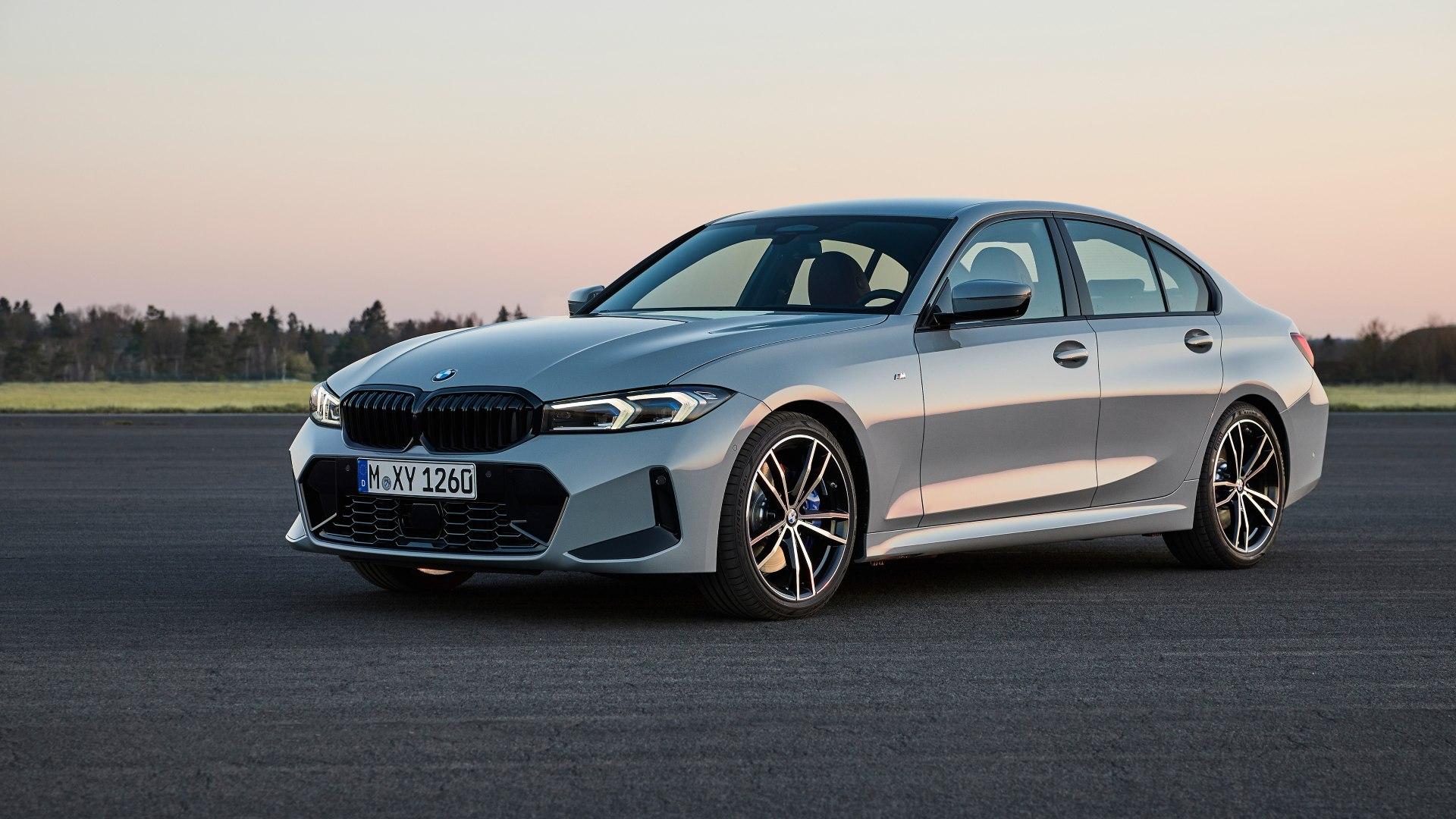
BMW Série 3 2022
What does a plug-in hybrid powertrain bring to one of the best luxury compacts?
Pros and cons
Pros
- Successful plug-in hybrid variant
- Realistic electric driving range
- Exemplary steering
- Heightened driving enjoyment
- Low gas consumption
- More compliant ride (hybrid)
- Comfortable and crafted interior
Cons
- Very low driving position
- Overly wide centre console
- Deficient defrosting
- Transmission sometimes harsh
- Reduced trunk space (hybrid)
- High price
Overview
Though BMW is launching two new all-electric models, the i4 and iX, its 2022 lineup still includes five plug-in hybrids. Among them is the 330e, a second generation of which arrived in Canada for model-year 2021. According to Natural Resources Canada, its 12 kWh battery provides 32 km of all-electric range with all-wheel drive. It also makes it eligible for $6,500 in government tax credits, in addition to significantly increasing power.
Almost no one will be buying a rear-wheel-drive 330e, the only 2WD 3 Series sedan still sold here. If BMW Canada lists it, it’s so as to offer a model for less than $45,000, which makes all variants eligible for the federal tax credit for plug-in vehicles.
The all-wheel-drive xDrive version costs $10,000 more; including destination fees ($2,245!), the 330e that will really interest buyers retails for $57,235. And that’s not counting the options and packages that cost an arm and a leg with BMW; the price tag of our test model came to over $68,000, before government tax credits.
BMW now builds the 3 Series in Mexico and Germany for the North-American market.
Verdict
What does the BMW 330e’s plug-in drivetrain add to one of the best luxury compacts on the market? First, real-world electric driving range that exceeds the official rating, without having to go lightly on the pedal. Next, better-controlled suspension damping than on the gasoline model, thanks to the weight of the battery, under the rear bench. And to top it off, the plug-in is no more expensive than the regular model, thanks to government rebates. If the 3 Series interests you, the 330e is the model to get.
Evaluation
Body, cabin and cargo space
Apart from the charging port door, the body reveals no sign of the BMW 330e’s electric powertrain. The same goes for the cabin, except for the specific instrumentation and a “Hybrid” button on the centre console.The BMW 330e is therefore as roomy inside as the other 3 Series cars. It can accommodate a young family if the front seats are not pushed back too far. However, with just 373 litres of trunk volume, passengers will have some tough choices to make about the luggage they bring. The lithium-ion battery accounts for a loss of more than 100 litres of trunk volume relative to the gasoline-only versions.
In any event, front occupants will have to cope with very low seating and an overly intrusive centre console. The highly adjustable sport seats provide remarkable support on long road trips, but the firm padding and long bottom cushion may not be to the liking of certain drivers.
A wide choice of trims and colours adds to the rich finish and impeccable fit of the interior. Crystal-clear screens combine with a good number of physical buttons and a large knob on the console to control the main functions. The interface requires some getting used to, but it is still among the most simple and logical of the prestigious brands.
However, BMW needs to work on the defrosting in cold or very humid conditions; windows fog up quickly unless the windshield defroster is going full blast. The base audio system also could be better, for a car that easily costs over $60,000.
Other highlights
Convenience: heated steering wheel, keyless entry and lumbar support are bundled in an options package; they should be standard in a $50k-plus car.
Instrumentation: very clear all-digital display. Information is abundant almost to the point of distraction. The steering wheel hides the top part of the instruments for tall drivers. The excellent head-up display compensates but is optional.
Safety features
- Antilock brakes with electronic brake force distribution, brake assist, fade compensation and automatic disc drying
- Stability and traction control
- Hill start assist
- Front airbags
- Front knee airbags
- Front side airbags
- Side curtain airbags
- Five adjustable head restraints
- Rearview camera
- Tire pressure monitoring
- Forward collision warning with automatic emergency braking
- Blind spot monitoring, lane departure warning, automatic high beams, automatic reverse braking and speed limit display (standard, 330i, 330e xDrive and M340i; unavailable, 330e)
- Front and rear parking sensors (standard, 330i, 330e xDrive and M340i; optional, 330e)
- Adaptive cruise control (included in Driving Assistance Package, M340i; optional, 330i and 330e xDrive; unavailable, 330)
- Lane keeping system (included in Driving Assistance Package, M340i; unavailable, other models)
- Semi-automatic parking and surround view monitoring (included in Premium Enhanced, Premium Excellence and Advanced Driving Assistance packages)
Crash test results
National Highway Traffic Safety Administration (NHTSA)Overall score: 5 / 5
Frontal impact: 5 / 5
Side impact: 5 / 5
Rollover resistance: 5 / 5
Insurance Institute For Highway Safety (IIHS)
Moderate overlap frontal impact: 4 / 4
Small overlap frontal impact:
- driver side: 4 / 4
- passenger side: 4 / 4
Side impact: 4 / 4
Rear impact: 4 / 4
Roof strength: 4 / 4
IIHS Top Safety Pick
Visibility
The glassed surface is adequate, but the low driving position and long, plunging hood make it difficult to situate the extremities. Surround view monitoring system facilitates parking. With outside mirrors that are too small and thick B-pillars, the blind spot monitoring system proves very useful.Headlights: the standard LED headlights obtained a 1/4 score in testing by the Insurance Institute for Highway Safety because of insufficient reach. However, the curve-adaptive LED projectors with laser light high beams received the top score for their overall exemplary lighting.
Mechanical overview
The big news since our evaluation of the updated BMW 3 Series, in 2020, is the 330e hybrid drivetrain. The relatively simple recipe adds an electric motor and lithium-ion battery to the 3 Series turbo 2.0‑litre four-cylinder. Combined output is 288 horsepower, 33 more than the gas-only version powering the 330i. The 310 pound-feet of torque slightly exceeds that of the combustion engine.The 12 kWh battery lodges under the rear bench and front of the trunk. According to Natural Resources Canada (NRCan), it is good for up to 32 km of all-electric range with all-wheel drive. NRCan indicates a charging time of 3 hours with a level 2 charger (240 volts). BMW puts it at close to 11 hours with a 120-volt residential charger. Like most plug-in hybrids, the 330e is incompatible with fast-charging stations.
The battery adds 166 kg to the weight of a 330i. That explains the 330e’s slightly slower acceleration, according to BMW specs, and the 13-percent higher fuel-consumption, as rated by NRCan, when the battery is depleted.
However, taking full advantage of the electric driving range can drop gas consumption below that of the 330i. During our summer test, we consistently exceeded NRCan’s estimated range of 32 km before the gas engine cut in. During a 237‑km highway run, we drove 49 km on the battery alone, lowering gas consumption to 5.2 L/100 km.
Driving impressions
In our test of the BMW 330i and the BMW M340i in 2020, we were thrilled by the precise and dynamic drive; stable on the highway, incisive on a sinuous road. The ride, on the other hand, was firm to the point of annoyance for certain people.Good news: the plug-in hybrid variant attenuates the irritation of that firmness. The rear suspension absorbs bumps better than on the gas models without affecting road holding in the least. The weight of the battery improves traction without hampering the excellent steering because it is situated entirely at the rear of the car.
The 330e seemed a bit less explosive than the 330i in terms of performance, but it handles passing and merging with flying colours. The transmission still displays some jerkiness in quick-shift manoeuvres, though it exploits the gas engine’s wide power band as precisely as ever.
The gas engine switches off frequently at stable speeds, even at zero electric range. Transitions are perfectly smooth, including when the electric motor restarts to give an extra burst of power.
Our main gripe with this exhilarating experience is that you cannot personalize the drive settings—steering, transmission, throttle—in hybrid mode, whereas you can in all-electric mode, which is more conducive to relaxed driving.
Other highlights
Braking: power, fade resistance and initial response are outstanding. Pedal is firm and very easy to modulate. Parts for the M Sport system are expensive.
Driver assistance: like most German automakers, BMW does not allow you to opt for traditional cruise control in models equipped with adaptive cruise. Fortunately, this one works smoothly overall. Lane departure warning and lane keeping assist are well calibrated and not too intrusive.
Features and specs
Price range (including shipping and preparation) | ||
| Minimum price | $47,235 | |
|---|---|---|
| Maximum price | N/A | |
| Price as tested | $68,130 | |
| Trim levels | 330e
330e xDrive
330i xDrive
M340i xDrive | |
Acura TLX | ||
Audi A4 | ||
Cadillac CT4 | ||
Genesis G70 | ||
Infiniti Q50 | ||
Lexus IS | ||
Mercedes-Benz C-Class | ||
Tesla Model 3 | ||
Volvo S60 and V60 |
| Engine, horsepower and torque | 2.0L turbo, direct injection 4-cyl.; 255 hp from 5,000 to 6,500 rpm; 294 lb-ft from 1,550 to 4,400 rpm (330i xDrive)
2.0L turbo, direct injection 4-cyl. with electric motor and 12 kWh lithium-ion battery; 288 hp from 3,800 to 6,500 rpm; 310 lb-ft from 1,450 to 3,600 rpm (330e and 330e xDrive)Range: 37 km (330e); 32 km (330e xDrive)
Level 2 complete charge (240 V): 3 hrs
3.0L turbo, direct injection 6-cyl.; 382 hp from 5,800 to 6,500 rpm; 368 lb-ft from 1,800 to 5,000 rpm (M340i xDrive) |
|---|---|
| Transmission | 8-speed automatic with manual mode |
| Front suspension | Independent with MacPherson struts |
| Rear suspension | Independent multilink |
| Front brakes | Ventilated disc |
| Rear brakes | Ventilated disc |
| Tires | 225/45R18
Front: 225/45R18; rear: 255/40R18
225/40R19
Front: 225/40R19; rear: 255/35R19 |
| Wheelbase | 285.1 cm | ||
|---|---|---|---|
| Length | 471.7 cm
471.8 cm (M340i xDrive) | ||
| Width | 182.7 cm | ||
| Height | 144 cm (M340i xDrive)
144.4 cm (330e and 330e xDrive)
144.8 cm (330i xDrive) | ||
| Curb weight | From 1,711 to 1,877 kg
1,877 kg | ||
| Towing | Not recommended | ||
According to Natural Resources Canada | ||
| City | Electric mode (combined city-highway): 31.5 kWh/100 km (equivalent to 3,5 L/100 km) gasoline only: 10.7 L/100 km (plug-in hybrid powertrain) | |
|---|---|---|
| Highway | Electric mode (combined city-highway): 31.5 kWh/100 km (equivalent to 3,5 L/100 km) gasoline only: 7.9 L/100 km (plug-in hybrid powertrain) | |
As measured by CAA-Québec | ||
| City | 5.8 L/100 km (plug-in hybrid powertrain | |
| Highway | approximately 19% driven in electric mode) | |
| CO2 emissions | 2,380 kg/20,000 km (plug-in hybrid powertrain) | |
| Fuel tank | 40 litres (330e and 330e xDrive)
59 litres (330i xDrive and M340i xDrive) | |
| Recommended fuel | Premium-grade gasoline | |
| 0-100 km/h | 6.7 seconds |
|---|---|
| 60-100 km/h | 4.2 secondes |