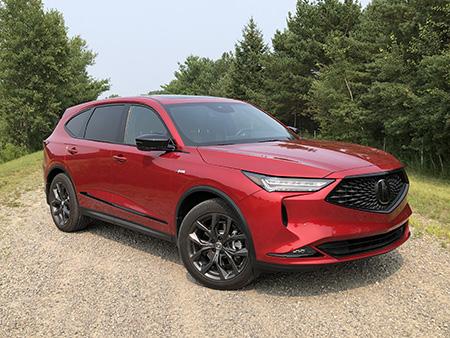
ACURA MDX 2022
One of the most affordable midsize SUVs on the market, but is there a sacrifice?
Pros and cons
Pros
- Spacious front and second rows
- Pleasant driving position
- Attractive dash
- Improved transmission
- Flexible and proven engine
Cons
- Weighty feel
- Overly light steering
- Frustrating infotainment system
- Controls sometimes bewildering
- Lack of trunk height
Overview
When the Acura MDX made its début, luxury midsize SUVs were just beginning to appear on the market. Twenty years later, the fourth generation MDX confronts a dozen or so eager rivals. Acura therefore spared no efforts in rejuvenating its flagship SUV, notably with an all-new platform, transmission and interior. While waiting for the arrival of the sporty Type S version and its turbo engine, expected at the end of 2021, a 3.5-litre V6 resumes service for the four variants listed in the catalogue, all with standard all-wheel drive in Canada.
Designated as the MDX’s main rivals are the Audi Q7, BMW X5 and Mercedes-Benz GLE, but also the Lexus RX L and Infiniti QX60, and not forgetting the Cadillac XT6 and Lincoln Aviator. Except for the QX60, Acura’s model is the only one of the group with a starting price under $60,000. Its maximum price of around $70,000 is also the lowest of the segment, again with the exception of the Infiniti.
Does that relatively affordable price come with big sacrifices for potential buyers? We tested the A-Spec version to find out. Like all MDX’s, our tester was assembled in Ohio.
(Video in French only)
Verdict
Appearances to the contrary, the Acura MDX A-Spec does not quite match the poise and vigor of its German or American rivals. The Type S variant may change that, but in the meantime, Acura’s flagship vehicle will continue to stand out for proven reliability, a very attractive price and a balance of comfort and handling that is superior to its Japanese competitors. The Acura MDX definitely deserves a close look, but its irritating infotainment system is a letdown.
Evaluation
Body, cabin and cargo space
Acura wanted to give its star crossover a sportier look. Its flowing body lines and dynamic cabin design are a success. Both stand out from the classic styling of the European competition.The 2022 Acura MDX is longer than its predecessor, so logically it offers more passenger space. While it is especially noticeable in the second row, the front seats, too, accommodate people of all sizes. The excellent driving position provides the elevated seating so dear to SUV enthusiasts without the impression of driving a tractor-trailer. Both the front seats and the second-row bench, which has a middle section that removes to create a pair of captain’s chairs, combine comfort and support for most builds.
The third row can seat adults if they tolerate having their knees on a level with their chin; at least the low seat reduces head contact with the sloping ceiling. With the bench folded down, cargo space is acceptable, though less roomy than the size of the vehicle suggests. The blame lies with the slanted liftgate and high trunk floor, a shortcoming of the MDX that Acura has long ignored.
Similarly, nothing has been done about the deficient ergonomics of the infotainment system, despite the arrival of a new system launched on the RDX in 2019. The centre screen is not to blame, as it is bright, comprehensive and up-to-date in terms of graphics. The culprit is the ultrasensitive and hard-to-use touchpad that serves as the main gateway to the system. Why bother reinventing the wheel when a touch screen, hard buttons and a well-designed central control knob are anchored in popular use?
In a similar vein, the push-button gear selector is less natural than a lever and doesn’t add extra storage under the console. The controls on the steering wheel require a certain adaptation, but they are more user-friendly than the touchpad on the centre console.
Happily, the climate controls and display are separate, making them much easier to use. The A-Spec and Platinum Elite trims’ 16-speaker audio system by ELS also deserves praise, a big step up from the ELS systems used on preceding generations of the Acura.
Other highlights
Instrument cluster: fully digital screen is standard; lettering is too small and detracts from the finely detailed graphics. Headup display restricted to Platinum Elite trim.
Safety features
- Antilock brakes with electronic brake force distribution and brake assist
- Stability and traction control
- Hill start assist
- Front airbags
- Front knee airbags
- Front side airbags
- Side curtain airbags
- Front seatbelt pretensioners
- Seven adjustable or folding head restraints
- Rear passenger alert
- Tire pressure monitoring
- Rearview camera with lens washer
- Forward collision warning
- Automatic forward emergency braking with pedestrian detection
- Lane departure warning with automatic steering assist
- Lane keeping assist
- Automatic high-beams
- Blind-spot monitoring with automatic steering assist
- Rear cross traffic alert
- Adaptive cruise control with traffic jam assist
- Front and rear parking sensors (standard, Tech, A-spec and Platinum Elite; unavailable, base model)
- Surround-view camera system (standard, Platinum Elite; unavailable. other versions)
Crash test results
National Highway Traffic Safety Administration (NHTSA)Overall score: n/a
Frontal impact: 4 / 5
Side impact: 5 / 5
Rollover resistance: Not tested
Insurance Institute For Highway Safety (IIHS)
Moderate overlap frontal impact: 4 / 4
Small overlap frontal impact:
- driver side: 4 / 4
- passenger side: 4 / 4
Side impact: 4 / 4
Rear impact: 4 / 4
Roof strength: 4 / 4
IIHS Top Safety Pick+
Visibility
Forward visibility is reasonably good, notably because the hood is flatter than before. As with many crossovers, thick roof pillars, narrow side windows and a high rear window complicate the view on the sides and to the rear. Finally offered as standard, the blind-spot monitoring system pairs with large outside mirrors to assist with lane changes. Surround-view cameras are included only on the highest-priced model; the regular back-up camera comes with a highly practical lens washer on all trims.Headlights: standard on all MDX models, the LED headlights were awarded the Insurance Institute for Highway Safety’s top score, meeting or exceeding all their test thresholds.
Mechanical overview
The 2022 Acura MDX launches a new platform that will eventually underpin all its usual cousins in the Honda lineup—Passport, Pilot and Ridgeline. As is customary, the automaker asserts that the new structure is more rigid than the former one. A more solid platform makes it possible not only to improve shock resistance, but also to refine road grip without overly firming up the suspension.For the first time, the Acura MDX features a double wishbone front suspension. More advanced than struts, wishbones usually provide sharper control on winding or bumpy roads. The variable-assist steering new this year has a similar aim. The multilink rear suspension has been redesigned.
While all the drive components of the MDX are revised, the engine on most of the versions is unchanged. It is still a 3.5-litre V6 dating back more than 20 years, to the second generation of the Honda Odyssey. First appearing on the 2014 MDX, the most recent version features direct injection and outputs 290 horsepower. That power is comparable to the naturally aspirated turbo V6’s of the competition and slightly higher than that of the turbocharged four-cylinder engines of the German SUVs.
Those who want a faster MDX will have to wait for the Type S variant with an all-new 3.0-litre twin-turbo V6 that will produce 355 horsepower and 354 pound-feet of torque. On paper, those numbers seem competitive for the type of engine. We look forward to testing this new powerplant to see if it is lives up to Honda/Acura’s reputation as an engine builder.
It also will be interesting to measure its impact on fuel efficiency. The 3.5-litre engine required 10.7 L/100 km during our largely highway test run. That’s better than Natural Resources Canada's official city-highway rating of 11.2 L/100 km, but superior to the result obtained in similar conditions at the wheel of a 335-hp BMW X5.
All engines are paired with a 10-speed automatic transmission with full-time all-wheel drive. The torque split varies between 90 percent to the front wheels, in a straight line on dry pavement, and 70 percent to the rear, in a tight turn or when the front wheels lose grip. Acura’s all-wheel drive system was also one of the first able to channel up to 100 percent of rear torque to either the left or right rear wheel.
Despite all that hardware, the MDX is not intended for off-road use, apart from the occasional excursion on gravel roads. As proof, the drive mode selector only offers programs designed for driving on the tarmac.
Towing capacity reaches 2,268 kg/5,000 lb only with a transmission fluid cooler, which is included in a $3,400 towing package available at dealerships. Without the cooler, capacity is limited to 1,360 kg/3,000 lb.
Driving impressions
Acura evokes exhilaration and performance in its promotion of the redesigned MDX. The elongated hood and robust profile reinforce that promise. In reality, exhilaration is not always present. Yes, handling is stable and reassuring, particularly at highway speed. The Acura MDX navigates turns with ease, but not much zest, compliments of precise but overly light steering. The weight of the vehicle is always palpable despite the new and improved suspension and the adaptive dampers. Sport mode sharpens the drive, but only minimally; Acura could have followed the lead of its German rivals, and upped the ante a bit.All the same, the MDX proves more dynamic than a Lexus RX L and the outgoing generation of the Infiniti QX60, with nothing to envy them in terms of comfort. It delivers a much smoother ride than a BMW X5, for example, with passengers well isolated from ambient noise. That in itself is noteworthy, since soundproofing has not always been a strong point of Acura.
The transmission represents the other major progress with this MDX redesign. Though a light bump is occasionally felt between the first two gears, this transmission surpasses the former gearbox in terms of smoothness and quickness.
It is well suited to the venerable 3.5-litre V6. The latter does not have the same low-rpm capacity of current turbocharged engines. But all is quickly forgiven thanks to its linear power curve and smooth revving performance, always accompanied by a refined and satisfying engine note.
Additionally, its relatively simple technology should guarantee more reasonable maintenance costs than that of the German competition.
Other highlights
Braking: successful innovative electric power assist system; satisfying pedal response with nice firmness right from the outset. Stable and straight panic stops.
Driver assistance: adaptive cruise control is acceptable, even though it still takes too long to resume speed after changing lanes. Acura still allows reverting to classic cruise by pressing a few seconds on the distance setting button. Lane departure warning is too sensitive, with steering corrections sometimes abrupt. Lane centering system is inconsistent.
Features and specs
| Price range (including shipping and preparation) | ||
| Minimum price |
$58,780
| |
|---|---|---|
| Maximum price |
$0
| |
| Price as tested | $66,280 | |
| Trim levels | MDX Tech A-Spec Platinum Elite | |
Audi Q7
BMW X5
Cadillac XT6
Genesis GV80
Infiniti QX60
Jaguar F-PACE
Land Rover Discovery
Lexus RX L
Lincoln Aviator
Mercedes-Benz GLE
Porsche Cayenne
Volvo XC90
| Wheelbase |
289 cm
| ||
|---|---|---|---|
| 503.9 cm |
503.9 cm
| ||
| Width |
200 cm
| ||
| Height |
172.4 cm
| ||
| Curb weight |
From 2,044 to 2,077 kg
2,059 kg
| ||
| Towing |
true
| ||
| Towing capacity |
Basic: 1,361 kg (3,000 lbs); with transmission cooler: 2,268 kg (5,000 lbs)
| ||
| According to Natural Resources Canada | ||
| City |
9.4 L/100 km
| |
|---|---|---|
| Highway |
12.6 L/100 km
| |
| Result | ||
| Temperature |
Not available
| |
| Temperature |
From 12°C to 28°C
| |
| CO2 emissions |
Not available
| |
| Fuel tank |
70 litres
| |
| Recommended fuel |
Premium-grade gasoline
Regular-grade gasoline accepted with slight power decrease
| |
| Acceleration as measured by CAA-Quebec | ||
| 0-100 km/h |
8.7 seconds
| |
| 60-100 km/h |
5.9 seconds
| |